What Side Do The Tassels Go On? The Ultimate Guide To Graduation Cap Etiquette
What side do the tassels go on? It’s a question that strikes fear into the heart of every graduate moments before they walk across the stage. In the whirlwind of ordering caps and gowns, practicing walks, and finalizing plans, this tiny detail can become a surprisingly big source of stress. One wrong move, and that symbolic tassel could be on the wrong side, turning a moment of triumph into a cringe-worthy memory. But fear not. This confusion is incredibly common, and the rules, while specific, are straightforward once you understand the tradition and the modern adaptations. This guide will dismantle the mystery, providing you with absolute clarity on tassel placement for every academic ceremony, from high school to PhD, ensuring you look and feel perfectly prepared for your big day.
The Golden Rule: A Simple Starting Point
Before diving into nuances, here is the foundational, most critical rule for what side do the tassels go on during the official ceremony:
For candidates (those about to receive their diplomas), the tassel starts on the right side of the cap and is moved to the left side after the diploma is officially received.
This single motion is the universal signal that you have transitioned from candidate to graduate. It’s a public, visual declaration of your new academic status. For everyone else—faculty, alumni, honored guests—the tassel remains on the left side for the duration of the ceremony. They have already completed their journey; the tassel on the left signifies their earned degree.
Why the Right-to-Left Motion?
The tradition is rich with symbolism. The movement from right to left is often interpreted as moving from the candidate's side (right) to the graduate's side (left). Some historical accounts link it to medieval European academic practices, where scholars would move their tassel from the right (the side of the sword, or the secular) to the left (the side of the heart, or the scholarly) upon receiving their degree. Regardless of its exact origin, the consistent right-to-left shift for new graduates is the standard across most American and many international academic institutions.
A Step-by-Step Timeline of Tassel Placement
Understanding when to move your tassel is just as important as knowing where it goes. The ceremony is a choreographed event, and your tassel is part of the routine.
1. Pre-Ceremony: The Right Side
As you line up with your fellow graduates, your cap should be on straight, and your tassel must be on the right side. This is your "pre-graduate" position. Take a moment before the processional to double-check. A quick mirror check or asking a friend, "Is my tassel on the right?" can save you from anxiety later. This is non-negotiable for the candidate.
2. During the Ceremony: Remain on the Right
Sit through the speeches, the national anthem, and the reading of names. Do not touch your tassel. It stays firmly on the right. You might see faculty or already-graduated individuals in the audience with theirs on the left—that’s correct for them. For you, as a candidate, the right side is your home until your name is called.
3. The Moment of Receipt: The Big Switch
This is the climax. When your name is announced, you will walk across the stage. The president or chancellor will likely shake your hand and may hold out a diploma holder (the actual diploma may come later). The precise moment your diploma is in your hands (or you have been officially recognized by the institution's representative), you move your tassel from the right to the left side of your cap.
- Action: Use your right hand to reach up and smoothly sweep the tassel from the front right corner of the cap to the front left corner.
- Timing: Do it after you have received the handshake/diploma and are turning to walk away. Do not do it as you are approaching or before the handshake. It is the final act of the conferral.
- Why it matters: This is the photographic moment. The image of you with the tassel on the left, diploma in hand, smiling, is the iconic graduation shot. Practice this motion in private so it feels natural.
4. Post-Ceremony: The Left Side for Life
Once you have officially graduated and your tassel has been moved, it stays on the left side for the rest of the ceremony. You will sit down, stand for the recessional, and walk out as a graduate. From this point forward, your tassel belongs on the left. This is also the correct placement for any future academic events you attend as an alum.
Special Cases and Exceptions: Not All Caps Are Created Equal
The basic rule is clear, but academic regalia has variations. Here’s how to handle them.
Doctoral Candidates: The Hooding Ceremony
For PhD and other doctoral graduates, the ceremony often includes a hooding. The hood is placed over your shoulders by a faculty member. The tassel rule remains the same for the cap: start on the right, move to the left after the hooding is complete and you have been recognized. The hood itself is a separate, significant symbol of your advanced degree, but it does not change the tassel protocol for the mortarboard.
Multiple Degrees in One Ceremony
What if you’re receiving both a bachelor’s and a master’s? This is rare but possible in some accelerated programs. The standard practice is to wear the regalia of the highest degree you are earning that day. Your tassel placement follows the rule for that highest degree's ceremony. If you are officially becoming a Master of Science, you follow the master’s protocol (which is the same: right to left upon receipt).
Military or ROTC Graduates
Graduates commissioning into the military through ROTC programs often have specific protocols. They may salute or perform other actions on stage. The tassel movement rule almost always still applies: move it right-to-left upon receipt of the diploma/commissioning. However, it’s wise to confirm with your ROTC unit advisor, as they may have a specific sequence that incorporates the salute.
Cultural and Religious Headwear
Many graduates wear cultural or religious head coverings (like a kippah, hijab, or turban) under or instead of the traditional cap. The tassel placement rule is adapted to the headwear. If the cap is worn over the head covering, the tassel goes on the right side of the cap. If a separate tassel is attached to the cultural headwear itself, the same symbolic right-to-left movement should be performed at the appropriate moment. The key is the symbolic act of transition, not the specific garment. Always coordinate with your institution’s diversity office or ceremony organizers if you have questions.
The History and Evolution of the Tassel
To fully appreciate the answer to "what side do the tassels go on," it helps to know where this tradition came from. The academic cap and gown trace back to medieval Europe, where universities were often run by the clergy. The long robes (gowns) kept scholars warm in unheated stone buildings, and the hoods originally served a practical purpose—to cover the head outdoors. The mortarboard—the flat, square cap—is believed to have evolved from the biretta, a square cap worn by medieval clergy and scholars.
The tassel itself was likely a decorative element, possibly denoting the wearer's institution or field of study through its color. Over centuries, it became the focal point for the "turning of the tassel" ceremony. This act became a standardized, dramatic moment in the 20th century as mass graduations for high schools and colleges became common. It provided a simple, visible, and repeatable ritual for thousands of students to mark their achievement simultaneously.
Modern Inclusivity and the Tassel
In recent years, a powerful and beautiful tradition has emerged that modifies the standard tassel rule: the collective turn. At many institutions, after the last name is called and the final graduate has moved their tassel, the ceremony speaker or president will instruct all graduates to turn their tassels together.
- What happens: The graduates, who have all individually moved their tassels upon receiving their diplomas, are asked to touch their tassels again, often as a group, to symbolize unity and the shared experience of the graduating class.
- Why it’s done: This creates a stunning visual finale for the ceremony and reinforces the community of the graduating class. It’s a moment of collective celebration.
- Key takeaway: You still must move your tassel individually right-to-left when your name is called. The collective turn is an additional, celebratory action that happens after everyone has properly graduated. Never wait for the collective turn to move your tassel the first time—you will be out of sync with the ceremony’s protocol.
Frequently Asked Questions (FAQs)
Let’s address the most common follow-up questions that arise after "what side do the tassels go on."
Q: Can I play with my tassel during the ceremony?
A: No. Once it’s on the correct side (right for candidates), leave it alone. Twirling, swinging, or fiddling with it is considered disrespectful and distracting. It’s a symbol of your academic journey, not a toy.
Q: What if my tassel falls off?
A: Stay calm. If it falls during the processional or while seated, discreetly pick it up and reattach it to the correct side (right for candidates). If it falls on stage, a faculty member or usher will likely help you. The most important thing is that the intentional movement from right to left happens at the correct moment. A minor mishap won’t ruin your day.
Q: Do I keep the tassel on the left after I take my cap off?
A: The rule applies to the cap. Once you remove your cap (often done for the national anthem or during certain prayers), the tassel’s position is irrelevant. Just ensure it’s correctly placed on the cap when you put it back on.
Q: What about the color of the tassel?
A: The tassel color is determined by your college or school within the university, not your major. For example, at many schools:
* Arts & Sciences: White or Gold
* Engineering: Orange
* Business: Drab (a brownish-tan)
* Education: Light Blue
* Law: Purple
* Medicine/Health Sciences: Green
Check your school’s regalia guide. The tassel’s color identifies your academic discipline to those in the know.
Q: I’m a guest. What do I do?
A: As a guest, you have no tassel protocol. You simply watch and applaud. If you happen to be wearing academic regalia as an alum, your tassel stays on the left side for the entire ceremony.
Practical Tips for a Flawless Tassel Moment
- Practice at Home: Put on your cap and gown. Have a friend or family member call your name. Walk toward them, shake hands (or accept a pretend diploma), and then smoothly move your tassel from right to left. Do this 5-10 times. Muscle memory is your friend on game day.
- Secure Your Cap: Use a bobby pin or two to secure the cap to your hair. The last thing you want is a wobbly cap or a tassel that gets caught as you move it. A secure cap makes the motion clean and confident.
- The "Diploma" Cue: Your brain needs a clear trigger. Your trigger is: "The moment the diploma (or diploma holder) is in my hands." Not when they start to hand it to you. Not when you touch it. When it is in your hands. This precise cue prevents you from moving it too early.
- Smile and Look Up: After you’ve moved your tassel, don’t look down at it immediately. Look up at your family in the audience, at the camera, or at the president. The photo should capture your joy, not your inspection of the tassel. You’ll have plenty of time to admire it later.
- Know Your School’s Specifics: While the right-to-left rule is universal, some schools have unique traditions. Does your school’s president give a signal? Is there a specific song? Read any ceremony instructions your school sends thoroughly. When in doubt, ask a faculty member or the ceremony coordinator.
Conclusion: More Than Just a Tassel
So, what side do the tassels go on? The answer is a story of history, symbolism, and shared experience. For the candidate, it begins on the right—a place of anticipation and journey. Through the deliberate, celebratory motion of moving it to the left, you publicly claim your new title: Graduate. This simple piece of cord and gold is a powerful totem. It connects you to centuries of scholars and to every single person in your row, all of whom are performing the same rite of passage at the same moment.
As you prepare for your commencement, remember that confidence comes from preparation. Understand the rule, practice the motion, and embrace the symbolism. When your name is called, you won’t have to wonder. You’ll simply reach up, make the move, and step fully into your future. That tassel on the left side isn’t just an ornament; it’s a badge of honor, a marker of a milestone, and the first visual sign of a new chapter. Wear it proudly.

Individual academic cap and tassels plus graduation gifts
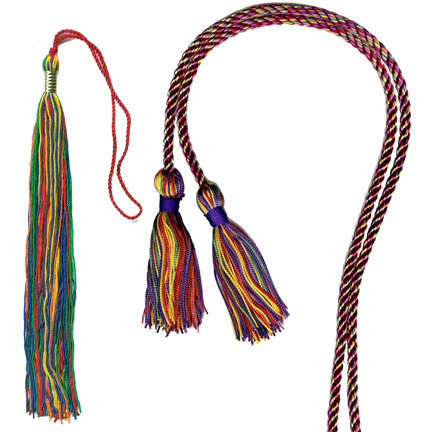
Welcome to Rainbow Graduation Tassels

Graduation Tassels | Honors Graduation
